
Do Students Learn from Writing Feedback from an AI Teaching Assistant?
Document Type
Book Chapter
Role
Author
Published In
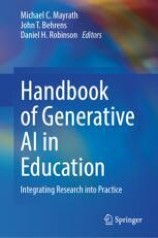
Handbook of Generative AI in Education: Integrating Research into Practice
Publisher
Springer Nature Switzerland
First Page
549
Last Page
573
Publication Date
9-13-2026
Abstract
This study examined whether students retain what they learn from artificial intelligence (AI)-generated feedback when they move from one writing task or course to another. Using JeepyTA, an AI teaching assistant implemented in two graduate courses with comparable structures and assignments, the study analyzed four major writing tasks to track how feedback patterns developed over time. Results showed that JeepyTA’s feedback supported short-term improvement in the first course, where students worked in groups. Most comments from the first assignment did not recur in the second assignment, and nearly all groups achieved higher scores. In transferring this learning to the second course, where students worked individually, improvement was far less consistent. Former group members who had received the same feedback in collaborative work diverged considerably in both the feedback they later received and in overall assignment performance, implying that shared exposure to feedback did not lead to shared learning that could be taken beyond that collaborative experience. There was also more variability in how effectively students applied the lessons from feedback across the two assignments within the second course. These findings indicate that AI-generated feedback can improve performance between assignments, but may not promote more lasting learning without structured opportunities for reflection and application.
Keywords
AI-generated feedback, Learning retention, Virtual TA, LLM, Generative AI
Suggested Citation
Liu, X., Wei, Z., Baker, R. S., Pankiewicz, M., Dai, Yunlang '26, & Vanacore, K. (2026). Do Students Learn from Writing Feedback from an AI Teaching Assistant? In M. C. Mayrath, J. T. Behrens, & D. H. Robinson (Eds.), Handbook of Generative AI in Education: Integrating Research into Practice (pp. 549–573). Springer Nature Switzerland. https://doi.org/10.1007/978-3-032-24819-0_20